
Inspired by the sudden success of Penguin, Pocket Books was launched in 1939 and became the first of the major US paperback publishers. Its founder, Robert de Graff, had confidently asked, “What possible reason could the public have for not wanting to buy paperbacks?”
The retail price was 25¢ – about US$6 in 2025 – from which authors and sellers received a smaller than usual share. De Graff said, “I felt that if a first class book, both editorially and physically, could be made the turnover would be sufficiently rapid then the wholesaler and retailer would not require the usual large margin.” Few would have complained when the large number of copies sold was revealed. Ultimately, the Agatha Christie novel Evil Under the Sun (below) sold almost a million copies. At a royalty of 2-4% that would mean about $20,000 to the author. In 1940s dollars.
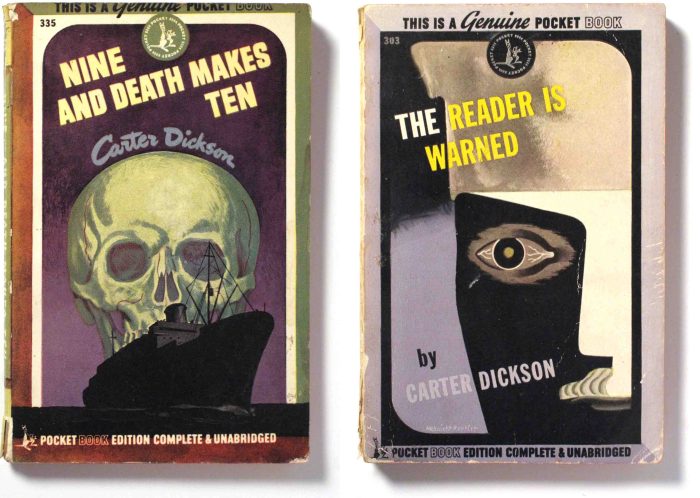
Pocket Books evolved rapidly through different cover styles, unlike Penguin who retained the 1935 grid for 25 years. One of the most distinctive designs lasted from 1942 to 1945 and those are what I have collected and present here. The illustration was framed by a rounded rectangle almost like a window in a grid designed by Laura Hobson. Title, author and branding was kept more or less in place while colours and placement of elements could be altered to suit individual covers.
The illustrations dominated the covers and Pocket Books was admired for their quality. Visual appeal was important because in the US paperbacks sold more on newstands and department stores where front facing display was the norm. Bookshops tended have spine display more, and were in any case often snobbish affairs where expensive books were offered to a middle class clientele. In the US, paperbacks were treated as packaged products with alluring designs to attract a mass market.
Art director Ed Rofheart commissioned designers who were acquainted with modern art, such as Leo Manso, George Salter and E.McKnight Kauffer. In the two covers above, Manso and Kauffer feature. Kauffer was Britain’s leading exponent of Art Deco in the graphic arts, on a par with A.M.Cassandre in France.

In the 1940s, US paperbacks often had modernistic covers, the artists influenced by the rising interest in the European art of Picasso, Dalí, Juan Gris, Raoul Dufy and others. Leo Manso was one of the main cover artists at Pocket Books and he later became an abstract artist exhibiting at the Museum of Modern Art and the Whitney Museum.

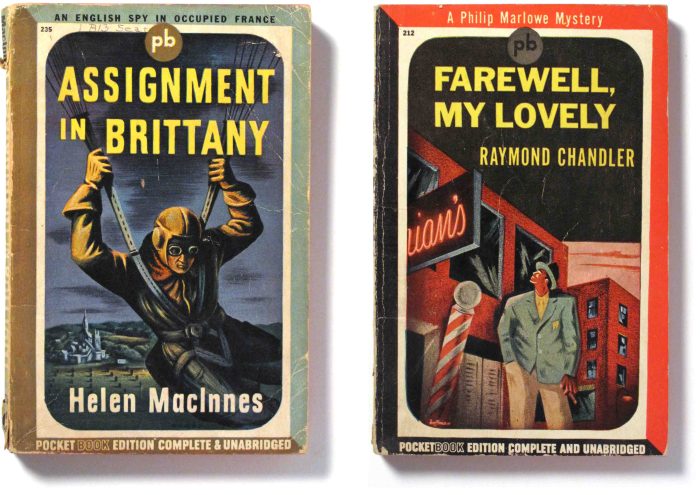
Raymond Chandler’s novel was in its tenth printing by Pocket Books since April 1943, giving some idea of the scale of popularity of a hit book.
Some of the information for this article comes from The Book of Paperbacks: A Visual History of the Paperback Book, by Piet Schreuders, 1981.

 PENGUIN SERIES DESIGN