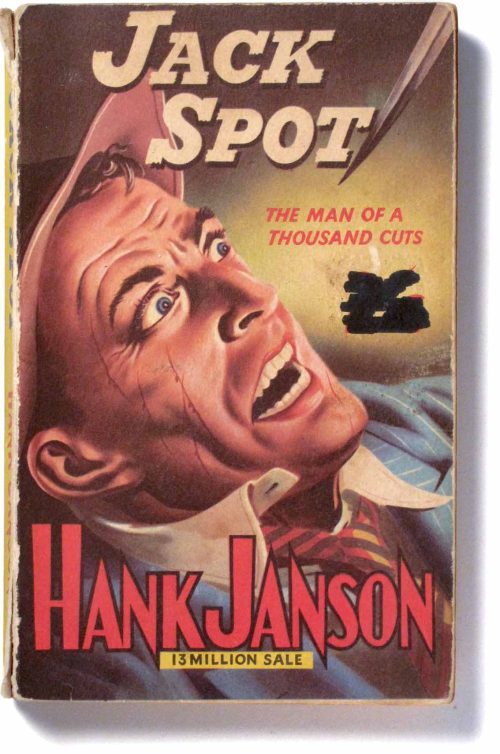
What was pulp fiction? Literally, it was a genre of fiction printed on cheap wood-pulp paper. It was written by workaday writers of sensational stories favoured by a mass audience. They were short books that could be read quickly as a distraction and they sold cheaply. The most successful authors sold in vast quantities, often outselling literary authors by orders of magnitude.
This site – Penguin Series Design – is dedicated to Penguin Books which made serious paperbacks a wide commercial success. But there is another story to the so-called paperback revolution, the story of pulp fiction, the broad ill-defined genre that preceded Penguin by one hundred years.
Most histories of pulp literature start with “Penny Dreadfuls”, the sensationalist weekly publications of crime and supernatural stories which were sold for a penny in Britain from the 1830s. The Penny Dreadful and its offspring were printed on wood-pulp paper, as are newspapers, and give the genre its name.
Classy publications were and are printed on cotton rag paper which is more expensive, better quality and longer-lasting. Pulp paper is cheap, low quality and it decays owing to the chemicals in the fibre. My pulp paperbacks are from the postwar era, some of which are shown in this article, and they are fragile and brittle and have faded to a light or mid-brown colour.
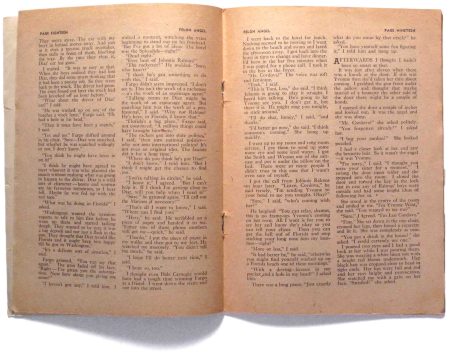
Pulp fiction is the ‘id’ of literature. It has a primal quality, a direct appeal to the emotions, it is angry, scared, sentimental or sexy, according to the subject. In the main, pulp was for working class readers who were not tertiary educated but were voracious readers. They were not read for education or refined aesthetic appreciation but for relaxation and it was enjoyed as a distraction by people who worked hard in factories, shops and offices, often for low wages.
So a criticism of pulp literature is, in part, a criticism of a class. It is snobbery towards a type of literature that doesn’t take itself as seriously as does its critics. And pulp fiction has not disappeared in the present time, it has just migrated to television and movies. Pulp fiction has moved up in the world, just look at Netflix.
CARTER BROWN

One of the most successful pulp writers, and a good case study, was Carter Brown.
The name was a pseudonym – one of the pseudonyms – of Alan G. Yates, an Australian writer who grew up in England. He wrote between 215 and 320 novels, and is one of the most published authors in history with reportedly 120 million books printed. They were translated into numerous languages and were adapted for radio, TV and cinema.
Like the famous writer of Westerns, Zane Grey, the name Carter Brown became a brand. So large and so consistent was his output that another writer published ten novels in his style and the public did not notice. A blurb in Felon Angel (above centre) is virtually a definition of the pulp crime genre …
They’re all the same…!! They’re all written for the man who goes for an intriguing mystery, a beautiful dame, tough action, slick dialogue, and a story that purrs along as smoothly as the chassis of the high-powered Carter Brown dame. They’re all the same and …that’s the way we like ’em!!
The covers of Carter Brown novels are a subject in themselves reflecting every trend in crime illustration. The three covers shown above are typical for their period and country of publication (mid-1950s Australia). They are hand-coloured photographs probably from agencies. The photo on Stripper You’ve Sinned was supplied by Twentieth Century Fox and features the movie star Debra Paget. I wonder if she knew.
The term pulp fiction, thanks in part to Quentin Tarantino, is often used to describe crime fiction only and this a mistake. There are numerous other genres of pulp – westerns, romance, erotica, science fiction and several others.
WESTERNS

American author Zane Grey (1872-1939) was the premier author of Western pulps, his name became a brand. These two Western Magazines, published long after his death, contain stories by authors other than Grey but are published under his brand.
He published about 200 pulp novels and is considered the Western pulp author of highest quality. For example, his 1912 novel Riders of the Purple Sage was published as a Penguin Classic. Between 1911 and 1996, 112 films were adapted from Grey’s novels and stories. In addition, three television series included episodes adapted from his work, including Dick Powell’s Zane Grey Theatre (1956–58)
The illustrations shown here are serviceable and follow the expectations of the Western genre, virility and conflict. The style is familiar from TV and movies. In the 1930s John Wayne himself featured in about fifty pulp-style Western B-movies.
It would come back – that wind of flame, that madness to forget, that driving, relentless instinct for blood. It would come back with those pale, drifting, haunting faces and the accusing, fading eyes, but all his life, always between them and him, rendering them powerless, would be the faith and love and beauty of this noble woman.
ROMANCE

A pulp genre made exclusively for women. Barbara Cartland proved its profitability and it has experienced a revival in recent decades, updated with the more relaxed attitudes to sex.
I can find no reference online to the any of the authors, whose names must be pseudonyms. Also unknown are the cover illustrators whose work is lively and direct.
Did the clear hazel eyes of the man she loved hide a twisted mind? Was his very nearness a danger to her life? Over and over again Eileen Gale faced these questions – until love became a torment.
CRIME
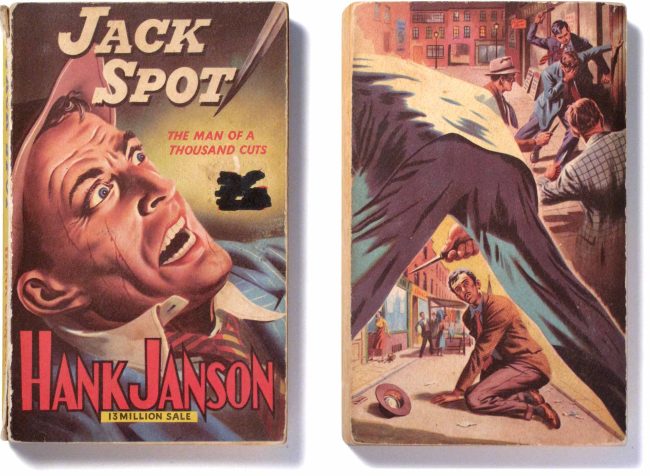
Crime is the genre that most people associate with the term ‘pulp fiction’. Hank Janson was the most popular and successful of British pulp fiction authors of the 1940s and 1950s. His books were violent “pseudo-American” thrillers sold in paperback editions sometimes featuring erotic cover art. It is stated on the cover of Jack Spot that 13 million Hank Jansons had been sold by 1958, and the series continued after that for two decades more.
The plot is a first person narrative of a gangster, Jacob Comacho, or Jack Spot, so-called because of a mole on his cheek.
The illustrations on the cover of Jack Spot are amongst the very Pulp crime covers I’ve seen, the most true to the form. The direct emotional ‘attack’ is unrestrained, in fact it would be hard for the writer to live up to it, and he doesn’t. The technical skill of the artist, whose name is not known, is plain to see and demonstrates the routinely high standards of illustration at that time.
I kept looking her. I couldn’t help looking at her. It was as though in that moment the full significance of being adult and male had hit me a powerful atomic blow in the belly.
EROTICA
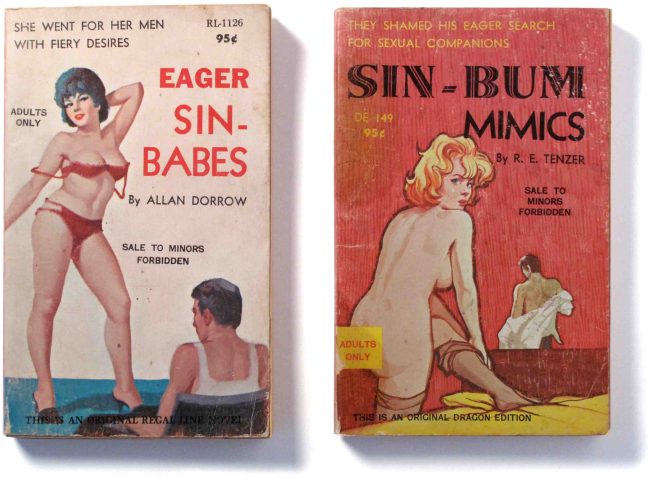
Sleaze or smut pulp was the most disdained genre, although that didn’t stop it being sold in local newsagents, sometimes from under the counter.
The literary quality was usually low but some books were groundbreaking for a conformist era that favoured euphemism in references to sex. Many broke taboos for example about same sex or mixed race relationships. There was a subterranean pulp literature with lesbian themes often written by women, but not for men.
These two books are amusing for the ineptness of the titles and the writing …
“Lust Pals. Those she made along the way steered her even further for that something she couldn’t find yet …she ran straight into the erotic feeling, satisfied only with the desires of eager seduction.“
SCIENCE FICTION

Science fiction has been described as the only new form of fiction created in the twentieth century. Its early success was largely fuelled by the pulp magazines in the 1920s. Hugo Gernsback published the first science fiction magazine, Amazing Stories, in 1926 and it set the pattern for others to follow.
Crest saw with growing despair that the lumbering transports, carrying invasion personnel and Destromechs, were going into hyper-space and not coming back. They had left the scene of the battle, leaving the fighting to the fleet of great Shark battleships. Encounter in Space.

 PENGUIN SERIES DESIGN